
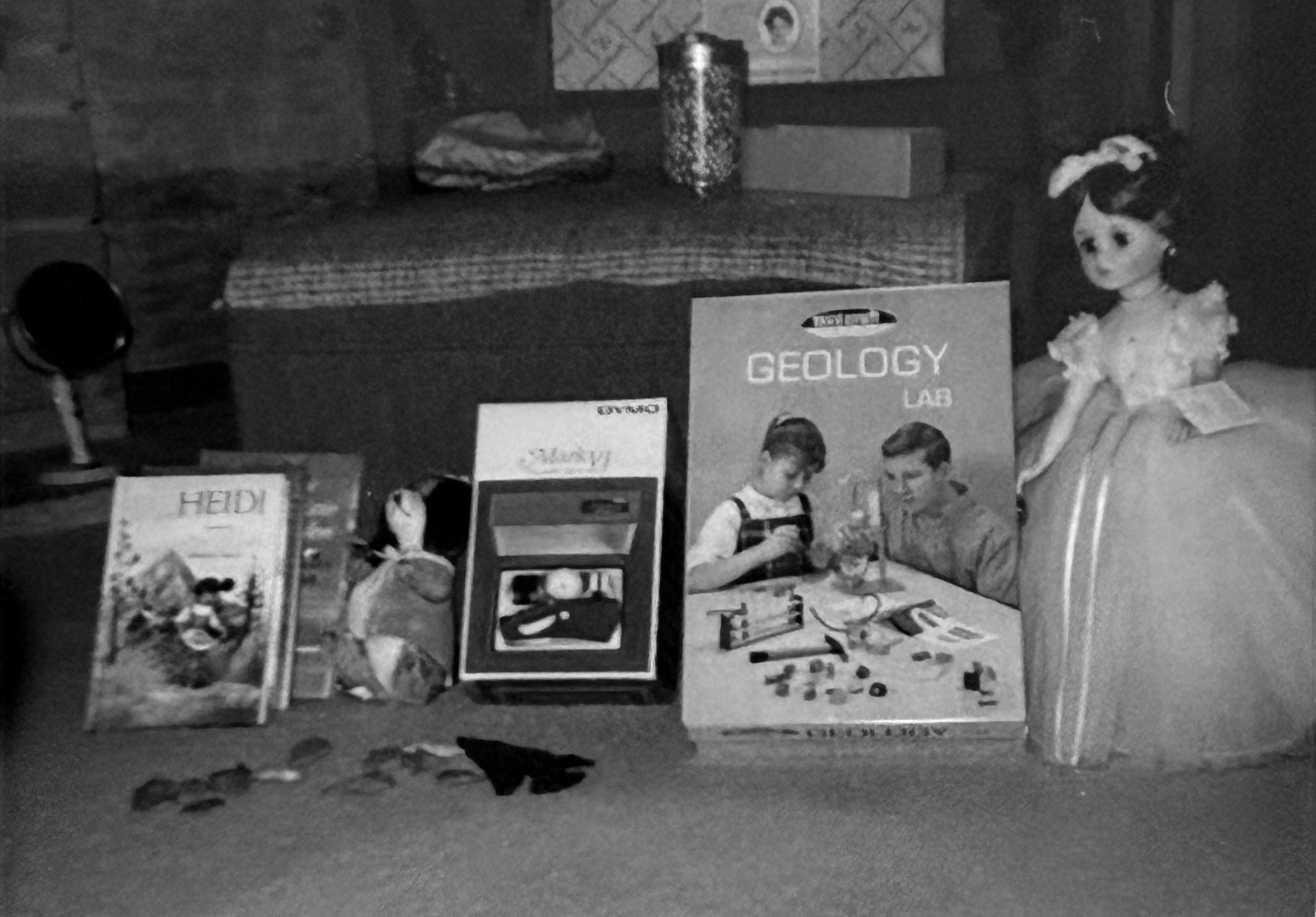
I enjoyed dolls when I was growing up in the sixties and seventies. Now it is time to simplify life—so I am saying goodbye to my dolls. (YouTube link to piano piece “Goodbye to Dolly“)
I would rather give them to a child who would appreciate them. However, times change and kids are not interested in dolls of the past. I don’t have children. My only niece has three boys.
I took pictures of them all and looked up their history online. As I did this, I found it fascinating. As I took the pictures, I realized how beautiful their faces are—as is their clothing. I started thinking about the people who design dolls. I saw a loving care not only for details but also for making something expressive and creative.
I had never considered this before. I grew up taking all this for granted. I loved my dolls and enjoyed their beauty . . . but I never considered that someone thought up all the specific features to make a doll come into being.
Before I sell or donate them, they deserve a farewell. They have been my faithful companions for about sixty years. I want to show them one last token of my love for them. After all, as Gayle Wray says:
Dolls are precious little reflections of joyous light, whose hope is only to delight.
― Gayle Wray (1961-2025) Artist and doll maker
Madame Alexander Dolls (1960s)
In the sixties, the Ike Saks department store in downtown Gadsden, Alabama had a section of high-end dolls and toys on the second floor. I would go and look at the dolls displayed on the shelves behind the counter. For three years, I asked for a Madame Alexander doll at Christmas—and Santa did not disappoint. It was a real splurge. Our family did not typically spend money on purely luxury items. As I recall, these dolls were about $50 to $60 at the time.
Madame Alexander, founded in 1923 by Beatrice Alexander, revolutionized the doll industry by combining artistry with storytelling. Her dolls brought characters to life through intricate costumes and lifelike features. What sets them apart is their attention to detail—from hand-painted faces to expertly tailored outfits. I believe this is what attracted me to these lovely dolls. When playing with them, I was not only wrapped up in their story, but I was also fascinated by the details in their hairstyles and clothing.
In my bedroom, there was an antique desk/bookcase. One side was a desk that folded out and the other side was a bookcase with a glass door. This is where I kept my dolls. The Madame Alexander dolls took center stage. They were symbols of aspiration and beauty—perhaps one day I would wear beautiful gowns and meet a prince.

This is Cinderella. What little girl did not want to be Cinderella? She was a lovely princess with a silver tiara and feminine blonde hair cascading down her back. I remember enjoying the textures of her gown as I ran my fingers over the soft, blue satin and intricate lace trim.

Her name is Elise. At seventeen inches, she is the largest of the Madame Alexander dolls that I have. An added touch is that she has jewelry—earrings, necklace, and a ring!

Godey wears the most elaborate dress. She is in a series called Portrettes—a set of elegant dolls. Her red hair is styled into a complex updo. Her pink taffeta gown has ecru lace overlay—and the hat gives her a special final touch. In fact, this series of dolls is known for detailed, historically inspired feminine clothing. Another unusual aspect of this doll is her articulated knees. I considered her the most beautiful of all my dolls. To me, she epitomized femininity and subtle beauty.
Tammy Dolls

This is Tammy wearing a dress my grandmother made for her. Tammy is twelve inches tall with red hair—she was available with other hair colors, but I must have asked for the red hair. Made by the Ideal Toy Corporation, Tammy competed with the Mattel Barbie Doll and had a more wholesome appeal and a less curvaceous figure.
I never owned a Barbie doll because I much preferred Tammy. In my child’s mind, Barbie’s body seemed grotesque with its super-defined curves. Tammy had a wholesome, fresh, teen look. Her wardrobe consisted of everyday fashions. The advertised slogan was “The doll you love to dress.”
Tammy was the doll I played with the most and she brought out my childhood creativity. My sister also had a Tammy doll. Hers had blonde hair. We constructed houses from cardboard. A neighbor’s father made doll furniture for me and then my father made some for my sister. We arranged the furniture into rooms and found everyday objects we could use as accents and decorations for their houses. Colorful handkerchiefs were bedspreads. Scraps of woven material were rugs. We had two small pencil sharpeners that looked like a TV. We used these for Tammy’s TV. We invented many adventures for our dolls.

My grandmother made identical wardrobes for my sister’s and my Tammy dolls. We loved playing with the various outfits. Here are two outfits Mama Coker made and two store bought outfits.

Bottom row: Store-bought clothes
I had several other outfits for Tammy as well as the 1965 red carrying case—“Evening in Paris.”


Another version of the Tammy doll was the 1964 Ideal Pos’n Tammy. She has full blonde hair with a long braid. Her body is bendable with posable legs. Her original outfit is a red leotard.
Polish Sawdust Rag Dolls

These dolls have a celluloid mask face which is hand-painted. I always loved the round mouth, pigtails, and soft cotton dresses.

After I got these dolls, there was a news story saying that they could burst into flames. (I believe this was possible if they were too close to a heat source.) But being a child, I did not understand that part. I had visions of them spontaneously bursting into flames in my room. My mother seemed unconcerned, but I was worried and put them out on the porch for several days.
My Three Favorites

When I was in about the third grade, my mother and I were in an antique store and I saw this doll behind the counter. I asked to see it and mother bought it for me. I loved her quaint outfit with the embroidered tulips on her apron and hat. To me, she has the most beautiful face of all my dolls.
I always thought she was made in Holland. In my recent research, I found that she is a Nancy Ann Storybook Doll from the Around the World series—and from San Francisco!
Doll designer Nancy Ann Abbott was born in 1901 and attended the College of Arts and Crafts in Oakland, California. She moved to Hollywood and had a small career in film. To pass time between takes, she made outfits for dolls—resembling the costumes in whatever movie she was working on. She gave them as gifts to her friends on set.
After her dreams of a Hollywood career faded, Nancy moved to San Francisco and opened a bookshop. She put some of her beautifully dressed dolls in her shop. They attracted more sales than the books. In 1936, she began her doll company in earnest in her apartment. Her only assets were $125 in capital, a kiln (her early dolls were bisque), a sewing machine, and an ironing board—and, of course, her talent and energy. She worked 16 to 18 hours a day.

When I was in elementary school, we went to the Smoky Mountains. We stopped at a souvenir shop where I saw this doll and instantly fell in love. The blue leather suede outfit is so soft and the beadwork and moccasins have beautiful details.
There was family lore about one of my great-grandmothers being an Indian. (However, I was never able to corroborate this story in my genealogy search.)
In researching this doll, I found that she is referred to as a Native American Indian Doll with Papoose Baby. She was made in the 1960s by Carlson Beads and Dolls in Maple Lake, Minnesota. The doll is a collector’s item and not a toy. Carlson dolls produced a variety of dolls dressed in costumes to represent various Indian cultural groups—hoping to help preserve the rich heritage of Native Americans.

Mother found this handmade rag doll at a yard sale and gave it to me one Christmas when I was in college. I displayed it on my bed because I loved it so much. I enjoyed seeing her every day. Everything about the doll is exquisitely done, from the embroidered face and button eyes to the blue cotton dress with small red flowers. She also has a half-slip and panties with lace cotton trim—such attention to detail!
Betsy McCall

In 1957, the American Character Doll Company obtained a license to produce Betsy McCall dolls. Her blue sleepy-eyes with molded eyelashes are lovely details. I have wondered if mother got this doll the year I was born, because I remember playing with it at a young age. Most of my dolls survived without incident. Betsy’s right leg is detached. Her leg probably broke off because I would change her clothes over and over. The outfit in the first picture is the lime green ballerina outfit.

TV Character Doll

I faithfully watched The Flintstones cartoon every week. The Pebbles character is adorable and this doll is one of my favorites. I love the Pebbles hairstyle—the red hair with the bone! This doll was made by Hanna Barbera/Ideal toys in 1963.
The TV theme music was catchy and I loved it so much that I bought the record. “Rise and Shine” underscored the opening and closing credits during the first two seasons. Beginning in season three, episode three, the opening and closing credits theme was “Meet the Flintstones.” I can still sing both songs!
From Childhood to Adulthood
It is bittersweet to let go of my cherished little friends. My goal is to find a new “forever home” for each little doll—a home where they will continue to be loved and cherished. And, I admit there are several that I decided not to part with just yet. I am not ready to break that connection.
In taking a closer look, I realize they were more than toys. When I was a child, they represented me taking on adult roles—feeding a baby doll, choosing clothes for my “teenage” doll, and making a home for Tammy. Looking back, they represent the optimism of a child—of growing up and learning to live and make decisions—perhaps even having a storybook life.
From my perspective as an adult, I have enjoyed looking at my dolls once more and learning about the artistry involved in creating them—someone designed those faces that I love. There are artists behind the dolls, humans behind the faces, and a person behind the story. Dolls are created to bring joy and delight—and that they did!
What They Taught Me
I am grown up now and on the downhill side of life, where everything looks very different. I did not become a princess. Life is not a fairytale existence. I learned life is what you make it. You often do not get to choose many of the details—and that is OK.
It would be easy to dismiss my dolls as childish playthings to simply set aside. However, over the past several months as I have taken their pictures, documented them, and reexamined their role in my life—I feel that I truly recognize their importance. It feels like a rounding off of their time with me.
Dolls represent the good in all of us. They brought companionship and taught me empathy, creativity, and problem-solving.
From Pebbles to Tammy to Godey to the Native American doll to the Polish rag dolls to the “Dutch” doll, I was surrounded by a variety of cultures and ways of being in the world. There was no judgment, only respect for each one. The differences made them each lovable and valuable in their own way.
I don’t want to forget that optimism or that hopefulness from my childhood. My desire is to remember to see the beauty of humans—to honor the diversity of humanity—just as my dolls taught me. Every person is valuable and deserves love and respect. That is what I carry with me throughout my life.




Leave a Reply
Your email is safe with us.