
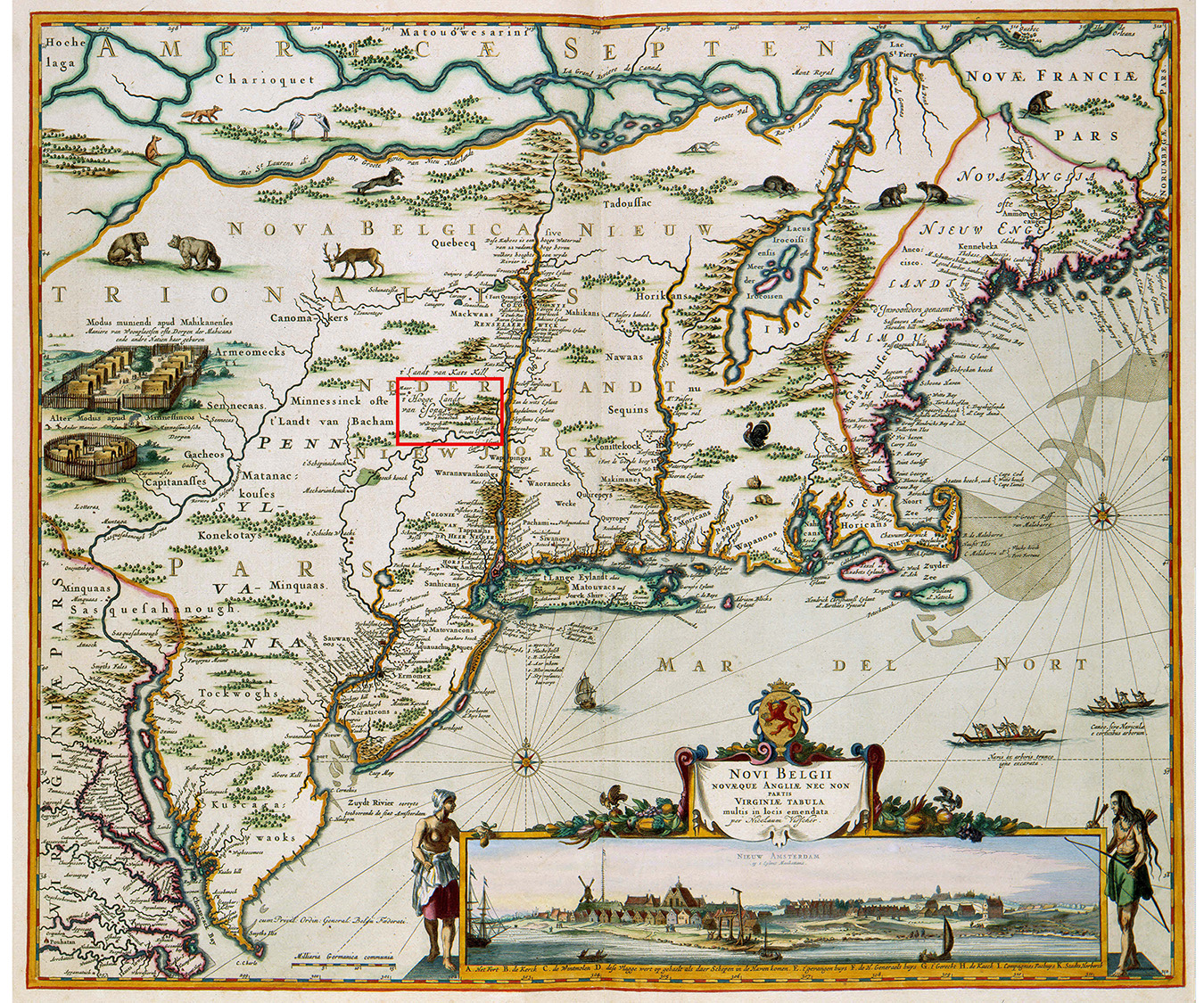
Life was hard for my ancestors—especially back in the seventeenth century. One family line came to New Netherland to escape a destroyed homeland. I am not sure life here was any easier for them or their children.
My previous blog post, “Life after Tragedy,” relates the story of my ninth great grandparents, Hans Jansen van Noordstrand and Rymerick (Volkert) van Noordstrand. They immigrated to New Netherland in 1639 after The Burchardi Flood destroyed their homeland. Their daughter Marritje (1636-1670), my eighth great grandmother, was three years old when they came to New Netherland.
New Netherland Beginnings
Henry Hudson’s 1609 voyage was one of the earliest European explorations of what is now New York Harbor. After stopping near present-day Staten Island, he traveled about 150 miles northward making contact with Indigenous Peoples. His descriptions encouraged colonization of this area, which became known as New Netherland.
Hudson described his impressions:
“When I came on shore, the swarthy natives all stood and sang in their fashion. Their clothing consists of the skins of foxes and other animals, which they dress and make the garments from skins of various sorts. Their food is Turkish wheat, which they cook by baking, and it is excellent eating. They soon came on board, one after another, in their canoes, which are made of a single piece of wood. Their weapons are bows and arrows, pointed with sharp stones, which they fasten with hard resin. They had no houses, but slept under the blue heavens, some on mats of bulrushes interwoven, and some on the leaves of trees. They always carry with them all their goods, as well as their food and green tobacco, which is strong and good for use. They appear to be a friendly people . . .”
“The land is the finest for cultivation that I ever in my life set foot upon, and it also abounds in trees of every description. The natives are a very good people; for, when they saw that I would not remain, they supposed that I was afraid of their bows, and taking the arrows, they broke them in pieces, and threw them in the fire . . .”
New Netherland is the epitome, and the noblest of all countries, a blessed province, where milk and honey flow.
— Jacob Steendam (1615-1672) Dutch poet and minister
Encouraged by Hudson’s reports—especially of an abundance of beavers—the Dutch sent fur traders and by 1621 formed the Dutch West India Company. Instead of competing with other countries such as France and Britain for territory, the Dutch concentrated on commerce.
Marritje and Juriaen
Six years after arriving, Marritje’s mother died and nine-year-old Marritje was apprenticed for a three-year term to Philip Garritsen, a tavern keeper and landowner. She learned sewing and cooking while the Garritsens took care of feeding and housing her.
In 1653, seventeen-year-old Marritje married thirty-one-year-old Juriaen Westvaal (1621-1667) at Fort Orange. Fort Orange, present-day Albany, New York, was the first permanent Dutch settlement in New Netherland.
Juriaen was born in Westphalia—in an area of what is now Germany. On June 6, 1642, at the age of twenty-one, he and twenty-three passengers left the Netherlands on “Den Houttyn”— a ship employed by Kilian van Rensselaer. Kilian contracted with European immigrant laborers for three to seven years to pay for their passage to the colonies. Juriaen worked seven years for Kilian on one of his Papscanee Island farms. [See the endnote for more information about Papscanee Island.]
Sailing from the Netherlands to New Netherland was no small feat. The journey took between 50 to 120 days, depending on the weather, winds, and the condition of the ship. Passengers slept below deck in narrow, closely packed bunks—where there was little light or fresh air. There were no bathrooms. Passengers and crew simply went to the front of the ship’s bow and emptied their bladder or bowels to the sea below. Some had chamber pots in their living quarters, but when it was full, it had to be carried up to the deck to be emptied. Many people wore the same clothes for the entire voyage. Their diet consisted mainly of butter, cheese, bread, dried fish, pickled goat meat, and apples. Sometimes they had eggs and meat from chickens, pigs, and sheep kept on the ship’s deck. Most ships also carried casks of lemon juice in order to prevent scurvy. I would say—at least for me—life would have to be pretty hard before considering such a journey.
Marritje and Juriaen Move to Esopus
In 1654, Juriaen and Marritje, along with other families, moved to the Esopus Creek area to establish a settlement. Juriaen was granted sixty-five acres of land next to Thomas Chambers. This was about the time their first child, Rymerick, was born. [See the endnote for more information about Esopus Creek.]

From 1654-1660, Juriaen worked as a farmer in Esopus growing oats, wheat, barley, and peas. During September 1655, the Indigenous People of Esopus attacked nearby New Amsterdam causing great alarm throughout New Netherland. Marritje and Juriaen’s second child, Nicholas, was born in 1657.
Building a Fort at Esopus
In May 1658, Thomas Chambers sent a letter to Dutch General-Director Peter Stuyvesant requesting protection against the Indigenous People of Esopus. Chambers stated that there were between sixty and seventy Christian people living there and that they attend divine services on all the proper days and that they maintain a hired lay minster at their own expense. He also wrote that they were, “obliged to remain” inside their houses, as they would be immediately attacked. He requested protection of forty or fifty soldiers from New Amsterdam, the capital of New Netherland.
In 1658, inhabitants along with some soldiers built a stockade or fort. Residents were told to tear down their houses and move them inside the fort. Though the Dutch and Indigenous People of Esopus were wary of the other, trade recommenced.
Marritje and Juriaen lived in a precarious environment for years due to disagreements and fighting between the settlers and the local Indigenous Peoples. In various attacks, some of the villagers were either taken prisoner or killed. Juriaen and his family managed to survive these incursions.
Reference to Juriaen was made in a report dated May 24, 1659, in which Sergeant Andries Bouwrense stated:
“Juriaen Westphal does his best to plough the land and fence it—I have lent him 69 lbs. of bacon, as he needed provisions. The oats are in the ground, all which your Honor has sent—the spring wheat came too late and the land is fenced nearly all the way around. The ploughing continues since your honor has sent the oxen. The oxen in which your Honor is privately interested draw well. He has sold his cows by order of your Honor. I have delivered the iron and ropes which your Honor has sent. No more at present, except to command your Honor to the protection of the Almighty God.”
In 1659, their third child, Johannes Juriaen (my seventh great grandfather) was born.
First Esopus War
Against direct orders from the New Netherland leadership, the Dutch were trading alcohol with the Indigenous Peoples—who had no experience with alcohol and started to abuse it. This eventually became the impetus for war. After too many drinks, a group of Indigenous People of Esopus became rowdy while celebrating around their campfire. A Dutch mob—fearful that the noise signified aggression—attacked the Indian village. In retaliation, some five hundred Indigenous People returned to Esopus and killed livestock, destroyed crops, and laid siege to the village. This war did not end until July 1660, when a treaty was negotiated. The Indigenous People of Esopus agreed to give up lands west of the stockade. In return, the Dutch gave gifts and promised to return the band of Indians sent to Curacao as slaves the year before. This was the First Esopus War (1659-1660). Several years of peace followed, although there were a few disputes over farmland. [See the endnote for Tensions with the Indigenous Peoples.]
The Dutch Reformed Church of Esopus
In August 1659, Juriaen and twelve others petitioned Peter Stuyvesant, and the Council of New Netherland to establish a Dutch Reformed Church at Esopus. They requested “a good, orthodox, and pious preacher.”
Rev. Harmanus Bloom, who had recently arrived from Holland, accepted the position. The people would need to “contribute yearly for his maintenance.” The villagers of Esopus promised to treat him well and provide a farm for him with a house, barn, cows, and other items to tend the land. The reverend’s pay would be a salary of “seven hundred guilders in corn, at beaver valuation.”

On December 26, 1660, Rev. Hermanus Bloom administered the first Lord’s Supper to his congregation of seventeen members. A plaque in the sanctuary of the present church memorializes this first communion and lists the names of those in attendance. In 1661 a church building was built inside the stockade.
Marritje and Juraien’s fourth child, Abel, was born in 1661.
It seems the villagers did not succeed as well as they had hoped to provide for the minister. Three years later, in 1662, Rev. Bloom was living in an upper room of Juriaen’s house, which was next to the church.
[See the endnote for more information about The Dutch Reformed Church of Esopus.]
Renaming of Esopus and Second Esopus War
In May of 1661, Peter Stuyvesant chartered the city of Wiltwyck, which had been called Esopus. He also authorized the expansion of the stockade.
In May of 1662, Nieuw Dorp (New Village) was organized three miles southwest of the stockade, on lands acquired from the Indigenous People of Esopus per the 1660 treaty. There were about 250 settlers in the area not counting soldiers. The Indigenous People resented this new village as the Dutch had not paid for the land nor returned the Indigenous People at Curacao as promised.
On June 7, 1663, the Indigenous Peoples planned a bloody ambush that came to be known as the Esopus Massacre. This conflict resulted in the loss of dozens of lives, destroyed property, claimed hostages on both sides, and nearly wiped out an entire tribe. The village of Niew Dorp was burned to the ground. The Esopus Massacre was the start of the Second Esopus War (1663-1664).
On July 28, 1663, Dutch forces attacked a large Indigenous Peoples fortification. And, on September 5, 1663, the Dutch attacked another stronghold. That winter was devastating for the Indigenous People of Esopus as they had no food and many died of starvation. On May 15, 1664, a peace treaty was agreed upon and vast amounts of land were given to the Dutch.
Marritje and Juriaen’s fifth child, Symon, was born in September 1663.
New Netherland became New York and Esopus became Kingston
Fifty years of Dutch rule in North America ended on September 8, 1664 when a British fleet arrived at Manhattan Island and forced the surrender of New Amsterdam.
The British, under Colonel Richard Nicolls, stationed soldiers at each of the Dutch settlements but honored the property rights of the Dutch people and allowed various Dutch institutions to continue to function. The Dutch church was allowed to continue undisturbed, even though it was governed from the Netherlands, as the British supported expansion of the Protestant faith as a force against the Catholic Church. The Dutch surname changed with each generation, but Britain required it to stay the same, so the Dutch changed their surname to a permanent and anglicized form. Fort New Amsterdam was renamed New York, in honor of England’s Duke of York.
Esopus, was renamed by the English as Kingston. An English officer and his group of soldiers moved into Esopus to live and do farm work.
Marritje and Juriaen’s daugther, Elsje, was born in 1666.
In 1667, Juriaen attended the “Meeting at Esopus” in which Dutch settlers petitioned Governor Nicolls to stop the tyrannical conduct of British soldiers under Captain Daniel Brodhead and that compensation be made for damages. Captain Brodhead was promptly dismissed from the army.
Jurian and Marretje’s Death
In 1667 or 1668, while he was guiding a troop of British soldiers, Juriaen Westvaal was apparently killed by a tribe of Indigenous Peoples from the north who were at war with the local Indigenous People of Esopus. It is believed that he was buried in the Old Dutch Churchyard of Kingston.
Jurian left six children, ages one to thirteen. His wife, Marretje, later married Jacob Jansen Stoutenburgh. She died at the age of 34 on January 10, 1670 in Kingston.
Their Children
At the death of Marritje the children were: Rymerick, age 19; Nicholas, age 16; Johannes, age 9; Abel, age 8; Symon, age 6; and Elsje, age 3. We do not know who cared for and raised the children after their parent’s death. It is likely that Marretje’s second husband, Jacob Jansen Stoutenburgh took care of them. According to records, five of the six children grew to adulthood in or near Kingston and were married at the Dutch Reformed Church of Kingston. Some records suggest that Johannes was raised by his father’s close friend, Thomas Chambers, at his Kingston estate, “Ye Manor of Fox Hall.”
Baptismal Records
Due to the remote conditions and the disruptions caused by the wars, the church records are very meager, so not all the baptismal records of Juriaen and Marritje’s children have been found.
After the Dutch Reformed Church of Kingston was established in 1660, there are records for their last three children: Abel born in 1661, Symon born in 1663, and Elsie born in 1666.
My Seventh Great Grandfather
Their third child, Johannes Juriaen Westvaal, my seventh great grandfather, married Maritie Jacobz Cool at the Dutch Reformed Church of Kingston in 1683.

In 1696 Johannes and 18 others including his brothers Symen, Nicholas, and his widowed sister Rymerick Quick bought land from the Minsi Indians along the Delaware River near the New York/New Jersey line.
The peaceful Minsi Indians were one of the three tribes of the Lenni Lenape people. About 1699 Johannes and his family moved to what was called the Minisink settlement. They were among the first white people to live in the area. Johannes oldest son Jurian and his friend Jacob Kuykendall hunted and trapped with the Minsi Indians as youths, and later traded with them.
Jurian married Jacob’s sister Styntie Kuykendall and Jacob married Jurian’s sister Sara Westfall. They raised their families and farmed there in the Minisink Valley along the Delaware River at peace with the Indians for many years. Jurian had the first apple orchard in the area.
Final Thoughts
Juriaen was twenty-one when he came to America as an indentured servant. After finishing his contract with Kilian van Rensselaer, he became a land owner and successful farmer. Against the backdrop of war, struggles, and hardships in New Netherland, Jurian and Marritje raised a family and survived the two Esopus wars.
They saw the beginning of the Dutch Reformed Church and witnessed the dawn of British rule in what had been New Netherland. Juriaen was forty-six when he was killed.
Not much is known about Marritje’s life other than she lived as most young women of that time. She married at seventeen and proceeded to have children every two or three years. She was thirty-one when Juriaen died. Marritje remarried and died at the age of thirty-four.
I am grateful for these hearty ancestors who forged a path in a new land. Because of their strength and tenacity, I am here today.
I am saddened by the conflicts with the Indigenous Peoples. I regret they were not allowed to flourish in their own cultures and choose whether they wanted to partake of what the Europeans offered. Instead, they were murdered, pushed aside, and dealt with unfairly. Surely there was enough for everyone—just as there is today. It seems humanity never learns.
Your ancestors are all the proof you need that progress is possible, not guaranteed. It will only be made if we keep marching, keep marching.
— Shaina Taub, American actress, singer, and musician (a quote from the musical Suffs)
Be the answer to your ancestor’s prayers.
Sean Sherman (b. 1974) American Oglala Lakota Sioux chef, cookbook author, and promoter of Indigenous cuisine (quote heard on Finding Your Roots)
Endnotes
Tensions with the Indigenous Peoples
Part of the tension was that the Indigenous Peoples were confronted with a culture that was more sophisticated. Marc B. Fried, author of The Early History of Kingston & Ulster County, NY, wrote:
“Theirs was a stone-age society that didn’t even have the wheel or wagons. They were becoming dependent on guns, iron, copper, wool cloth, and so many other things that they were trading for. And by the time of the settlement, many Lenape Indian tribes had been decimated by disease; their population was declining. With all these changes they were demoralized, as anyone would be.”
Papscanee Island
Papscanee Island was originally one of the areas where the Mohican tribe lived. The Island was very fertile with many rivers and streams. In the early 1600s, the Mohican Nation was removed from Papscanee Island and other areas in the region. They eventually settled in what is now Wisconsin.
Rensselaer, a wealthy Dutch businessman, was deeded land in New Amsterdam by the Dutch West India Company in 1630. In 1637, Kilian purchased Papscanee Island, south of Fort Orange and along the east side of the Hudson River. He split it into thirds and hired tenants to farm the land.
In the 1990s, with the island at risk of being developed, Open Space Institute (OSI) purchased the property to protect it. They partnered with Rensselaer County to create the Papscanee Island Nature Preserve.
The county managed the Preserve for more than two decades. In 2009, the island was identified as eligible for inclusion in the National Register of Historic Places worthy of preservation for its historical and archaeological significance. In 2021, OSI donated the land back to the Mohican Nation.
The Papscanee Island Nature Preserve is a 156-acre natural area and has access to over two miles of Hudson River shoreline. It has hiking trails and picnic areas. The Preserve is also home to numerous federally endangered species.
Esopus Creek
Esopus Creek is a tributary of the Hudson River that drains the east-central Catskill Mountains. Its name comes from the Esopus tribe of the Lenape who lived around the lower Esopus. The creek’s wide valley made it an ideal trading route for the Esopus and other Lenape who harvested beaver pelts which they traded with the Europeans.
Dutch Reformed Church of Esopus (Kingston)
Often referred to as “The Cathedral of Kingston,” the Old Dutch Church was a part of the Dutch Colonial village of Wiltwyck which was a trading outpost in the colony of New Netherland. The original church structure, built on the present site in 1660, was one corner of the Stockade which Peter Stuyvesant ordered built as fortification. Wiltwyck later became the village of Kingston after the British took over the colony and renamed it New York. The original structure was largely destroyed by fire in the Esopus Indian raid of 1663. Rebuilt and enlarged several times, the church was again burned during the American Revolution by British forces in October of 1777.
During the Revolution, the church, and its congregation, aligned itself with the rebel or patriot cause. As a result, in November of 1782, Gen. George Washington visited the church. A hand-written letter by Washington regarding his reception at the church is proudly on display in the Narthex of the church. It is significant to note that during the entire eight years of the American Revolution, this was Washington’s only reference to a religious institution.
The present structure was designed by renowned architect Minard LaFever and was completed in 1852. Constructed of massive cut, native bluestone, the imposing edifice is crowned with what was at one time the tallest steeple in New York State. By city ordinance, no structure in Uptown Kingston could be constructed taller than the steeple of Old Dutch Church. This has allowed for the unique historic character of Uptown Kingston to be preserved and the steeple stands a beacon which forms part of the skyline of the City of Kingston and can be seen, literally, for miles.
The interior, designed by Minard LaFever, is in the style of Christopher Wren and is considered unique for this country. Utilizing the Christian symbolism of 3 (the Trinity), 5 (senses), and 7 (days of creation), LaFever designed a Sanctuary that has been described as being “architecturally perfect.” At the head of the Sanctuary is a 15-foot illuminated stained glass window depicting the Presentation of Jesus in the Temple, created by Louis Comfort Tiffany and installed in 1891.
In 2008, Old Dutch Church was declared a National Historic Landmark and in 2009 they celebrated their 350th Anniversary. They are an active and open congregation with Sunday School and services weekly. They have choir, fellowship, arts series, and mission & outreach to the local and global community.
The Old Dutch Church is the sixth oldest Reformed Church in America, having a continuous ministry and worship on practically the same ground. The baptism and marriage records, dating from 1660 (recorded in Dutch until 1810) are the most complete and among the oldest in the country still in existence. All services were in Dutch until 1809. Fifty Reformed Churches, stretching from the east side of the Hudson River through the New Jersey/Pennsylvania border can trace their roots to Old Dutch.
Timeline
1621 Juriaen Westvaal born
1636 Marritje (Volkert) Van Noordstrand born
1639 Marritje’s family immigrated to New Netherland
1642 Juriaen Westvaal immigrated to New Netherland
1653 Marritje and Juriaen are married
1654 They move to Esopus
1654 Their first child, Rymerick, was born
1657 Their second child, Nicholas, was born
1658 The fort at Esopus was built
1659-1660 The First Esopus War
1659 Their third child, Johannes Juriaen, was born
1660 The Dutch Reformed Church was established
1661 Their fourth child, Abel, was born
1663-1664 The Second Esopus War
1663 Their fifth child, Symon, was born
1664 The British took over rule of New Netherland
1668 Their sixth child, Elsje, was born
abt. 1668 Juriaen was killed
1670 Marritje died
1683 Johannes Juriaen Westvaal, my seventh great grandfather, married Maritie Jacobz Cool at the Dutch Reformed Church of Kingston



Leave a Reply
Your email is safe with us.