
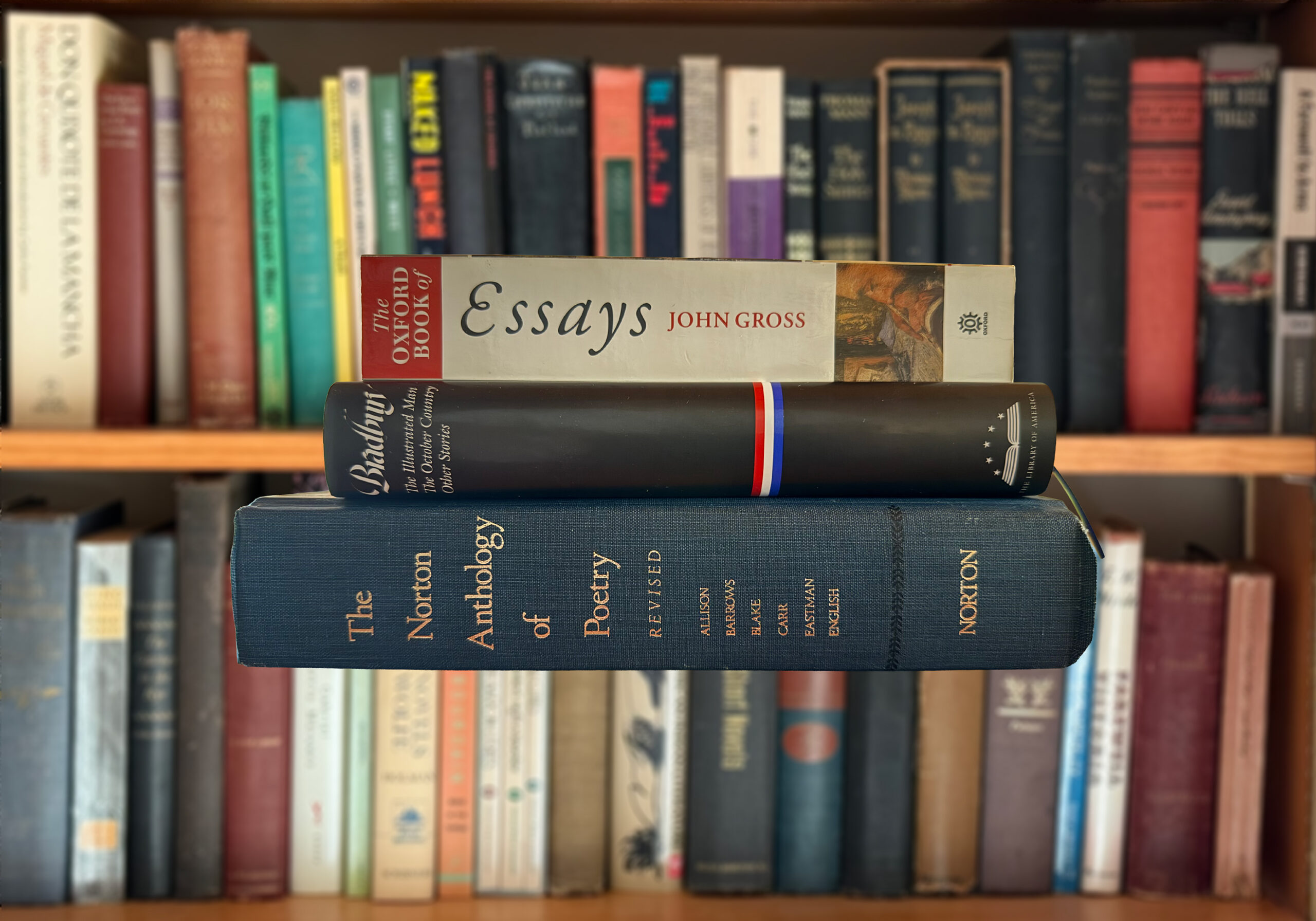
Reading is a challenge for me. I like the idea of reading and enjoy it when I actually do read. However, I have trouble making time and settling down long enough to read. While watching a YouTube video about writing, I came across a reading program by Ray Bradbury: read one poem, one short story, and one essay every night. It sounded easy enough—I could just read short examples of these. I did not realize when I started that Bradbury said to do it for 1,000 days!
I wanted to see if Bradbury’s method could help me build a consistent reading habit, and maybe even spark my creativity. So, a week ago I started the Ray Bradbury reading program. To that reading routine, I added two song lyrics, a book I enjoy (currently Every Good Boy Does Fine by Jeremy Denk), and a book about writing lyrics.
While I haven’t yet read Bradbury’s fiction, I’ve come across much of his advice to writers. He is always practical and down-to-earth. One of the most celebrated twentieth-century writers, Bradbury worked in a variety of genres, including fantasy, science fiction, horror, and realistic fiction.
What have I learned after one week? First, that I want to keep a log of what I have read. At the beginning, I started with a pile of books, mostly compilations of poetry, short stories, and essays. I looked through the table of contents to find the shortest ones to read each night. Admittedly, it was not an especially noble or enthusiastic beginning, but I take consolation in the fact that it was, at least, a start. I discovered that I prefer order and that maybe I should go through the volumes from front to back, logging the titles each day after reading.
I found some wonderful sentences that made me stop and reread them over and over again.
What he liked he disliked a bit; where he disliked he liked also. He rather dislikingly liked everything that happened.
— James Stephens (1880-1950) Irish novelist and poet
from his essay “Finnegan’s Wake”
The effort which people put up to avoid thinking might almost enable them to think and to have some new ideas. But having ideas produces anxiety and malaise and runs counter to the deepest instincts of human nature, which loves symmetry, repetition, and routine.
— Sir Lewis Namier (1888-1960) British historian
from his essay “Symmetry and Repetition”
It’s a high building in Singapore that holds the only beauty for this San Francisco day where I am walking down the street, feeling terrible and watching my mind function with the efficiency of a liquid pencil.
— Richard Brautigan (1935-1984) American novelist, poet, and short story writer
from his short story volume, Revenge of the Lawn
How about Them Lunch Toters,
Ain’t they a bunch?
Goin’ off to work,
A-totin’ they lunch.
— Mason Williams (b. 1938) American classical guitarist, composer, singer, writer, comedian, and poet
from the poem, “Them Lunch Toters” in his book The Mason Williams Reading Matter
For some reason, this Mason Williams poem made me laugh uncontrollably. I read it aloud to get the full effect. It reminded me of a childhood neighbor who likely spoke in a similar manner. Williams has other poems in this same vein.
After the first week, I have filled my mind with ideas. I have read works from a wide variety of genres and eras. Brautigan’s quirky stories are short. Perhaps I could try writing a short story. Emily Dickinson’s poems are lovely and elegant. Mason Williams’s poems are funny and down-to-earth. Every writer has their own voice.
Bradbury said we do not have to read good material—just read. The routine builds consistency and inspires creativity. It feeds my mind with diverse and, often, new ideas. As these ideas percolate, they should generate creative thoughts and help improve my writing.
“I’ll give you a program to follow every night, a very simple program . . . one poem a night, one short story a night, one essay a night, for the next 1,000 nights. From various fields: archaeology, zoology, biology, all the great philosophers of time, comparing them . . . But that means that every night then, before you go to bed, you’re stuffing your head with one poem, one short story, one essay—at the end of a thousand nights . . . you’ll be full of stuff, won’t you?”
— Ray Bradbury (1920-2012) American author and screenwriter
“Telling the Truth,” the keynote address of The Sixth Annual Writer’s Symposium by the Sea
I will continue this program and provide updates. The first week has been entertaining, educational, and inspiring. Perhaps you will try this program! Let me know in the comments. And, feel free to suggest short stories, poems, and essays that you enjoyed reading.




Leave a Reply
Your email is safe with us.